Twelve years ago, I had a lot to learn about photography (still do, of course). My camera was good enough for me, but not really a “good” camera. I didn’t know anything about processing or editing images. I just knew that I liked travelling and taking nice pictures.
And as far as I knew, “taking nice pictures” meant capturing what was right in front of me before it moved away again. I was always rushing and trying to capture things that had already happened: animals that were already hiding from me, sun rays that were already moving, weather that was already changing. But you can’t capture a moment if it’s already passed.
Then I met Tigre. A beguiling ocelot born in the wild, but destined to live out her days at a wildlife sanctuary. I worked with her in 2008 and in 2010, for several months at a time. Our days were spent exploring the Bolivian rainforest, pushing through trails, chasing snakes, catching bats and climbing trees. I would follow her anywhere, with only one rule: this was her forest, and she was in charge.
That approach wasn’t always as adrenaline-fuelled as it sounds. Amidst all the chasing and exploring and climbing, we made plenty of time for that other favoured feline pastime: sleep. Tigre liked to sleep on my feet. I can’t even guess how many countless hours I have spent standing motionless in the rainforest, watching an ocelot sleep peacefully on my boots. One hour at a time, or two, three....it didn’t matter. I learned to stop chasing, and turn my attention to other things. I got good at waiting. I got good at listening to the forest and becoming aware of the wildlife around me (before it had decided to hide). I learned the first thing that any aspiring wildlife photographer needs in spades: patience.
If I can begin to consider myself a photographer, it was Tigre who taught me everything I know.
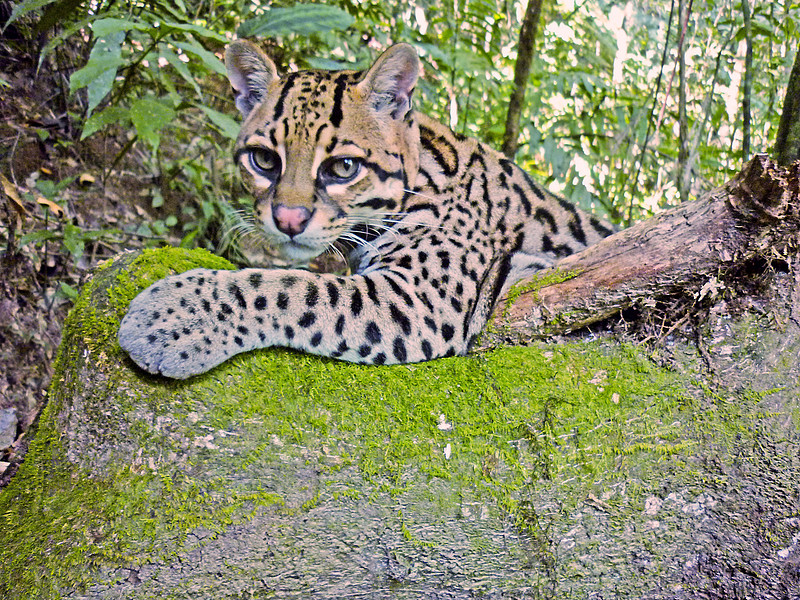 Ocelot, Bolivia


